
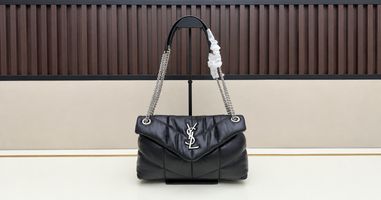
YSL Loulou Puffer Bag: Packing and Usable Capacity
Packing affects YSL Loulou Puffer bag well before the interior reaches full capacity. Thick or rigid items change how space is shared,while heavier filling can influence access,weight distribution,and the way soft quilted panels settle. Moderate fill usually keeps contents manageable without making the silhouette feel overly fixed.
Two people using the same format can therefore have very different experiences. Item form,placement,and access frequency can matter more than a simple count of what fits inside.
1. Why Packing Changes More Than Capacity
Soft construction reacts to contents differently from a rigid handbag. Objects do not simply occupy a fixed box; their placement can influence nearby space and how the bag settles once carried.
This makes fill level an important part of the experience. A lightly packed interior behaves differently from one where most available room has already been used.
Weight can concentrate in one area. Thick objects can push nearby pieces into different positions. Small changes in placement may also affect how the exterior sits.
Capacity is therefore better considered as a working environment rather than a single measurement. What matters is how the interior behaves after personal items are arranged inside.
2. What Happens When the Bag Is Lightly Filled
Light packing creates more freedom inside. Items do not have to occupy exact positions simply to fit,and frequently used pieces can remain separated from less important belongings.
A phone or card holder can stay easier to reach without disturbing the rest of the interior.
The tradeoff is movement. Smaller pieces may shift when more room surrounds them,especially if weight is concentrated on one side.
Placement therefore matters more than quantity under light loading. Keeping dense objects closer to the center and separating small loose pieces can make the interior more predictable without adding unnecessary contents.
This setup favors quick access and low interior pressure rather than maximum use of every available corner.
3. Why Moderate Packing Can Feel More Stable
Moderate fill changes how objects support one another.
When several pieces occupy enough room to limit unnecessary movement,contents tend to stay closer to their original positions. This can reduce shifting while walking or changing the bag from one carrying position to another.
The useful point is not a specific percentage of capacity. It is the stage where objects have enough surrounding support without being pressed tightly together.
Different combinations reach that point differently. Three slim pieces may settle comfortably,while two bulky accessories can create a denser arrangement even when fewer objects are present.
At this level,contents tend to stay in place without becoming tightly compressed. The interior remains flexible,but individual items no longer move as freely as they do under very light loading.
4. How Item Form Changes the Way Space Is Used
Exterior dimensions cannot predict how every personal item will behave inside. Flat objects use depth differently from thick cases,and rigid pieces cannot adapt to nearby gaps in the same way softer belongings can.
This is where YSL Loulou Puffer bag capacity becomes less about total volume and more about the combination of objects carried together. Two groups of belongings may appear similar in quantity yet create very different interior arrangements.
A rigid glasses case can establish a fixed boundary that nearby objects must work around. A slim card holder can use remaining space more efficiently. Rounded or irregular pieces may leave small areas that exist physically but are difficult to use.
Thinking in terms of form makes the comparison more realistic:
• Which items create fixed edges?
• Which pieces can shift slightly when space changes?
• Which objects need direct access rather than the most efficient position?
These questions reveal how much of the interior can actually support a personal carrying setup.
5. Why Overpacking Creates Friction
Problems usually appear before the interior reaches an obvious physical maximum.
As space becomes tighter,each object has fewer possible positions. One thick accessory may force another piece upward. A case placed close to the opening can make closure less straightforward. Contents that previously settled independently begin competing for the same usable area.
Pressure also reduces tolerance for small changes. Something that sat comfortably earlier may begin pushing against another object once one extra item is added.
The bag may still close,but the interior starts demanding more deliberate placement. Small differences in angle or position become necessary simply to keep everything within the available space.
Overpacking becomes inefficient once maintaining the arrangement requires noticeable effort. At that point,the problem is not lack of theoretical capacity but loss of practical flexibility.
6. How Carrying Changes Once More Is Packed Inside
Fill level also changes weight distribution.
A lightly filled bag can allow heavier objects to move toward one side. Greater fill may stabilize their position,but dense items grouped together can create a concentrated pull that changes how the bag settles against the body.
That is why evaluating YSL Puffer for regular use should include the weight and position of personal belongings,not only whether everything fits.
A few compact but heavy objects can affect carrying more than several lightweight pieces. Placement near the center usually keeps weight more balanced than grouping dense contents toward one end.
The question here is not whether shoulder or crossbody wear is preferable. It is how the same carrying method changes once weight enters the bag and begins influencing balance.
Space can still remain available even after carrying comfort has started to change. That distinction is worth noticing before judging capacity only by what can fit inside.
7. Where Soft Construction Reaches Its Practical Boundary
Soft construction can absorb small changes in fill,but dense contents eventually begin to control how the bag sits.
One sign appears when interior objects start defining exterior areas more strongly than the original padded form. Hard edges may become easier to notice from outside,and sections that previously settled softly can begin holding a more forced position.
Closure can provide another signal. If the top area needs compression before closing,the interior is no longer simply using spare room; contents are beginning to influence how the bag operates.
A third sign is reduced flexibility. Soft construction normally allows small shifts as the bag moves. Dense loading can restrict that movement because interior objects begin holding panels in fixed positions.
The practical boundary appears when contents stop adapting to the bag and the bag starts adapting visibly to the contents.
That point matters more than whether one final accessory could still be inserted.
8. Why Empty Space Can Be Functional
Unused room is not necessarily wasted capacity.
For Yves Saint Laurent Loulou Puffer bag use,a small amount of interior clearance can serve a practical purpose. It creates room for fingers to reach around an object,allows frequently used pieces to come out more easily,and prevents every addition from forcing a new arrangement.
This matters when contents change during the day. A receipt,folded paper,small personal item,or temporary purchase may need somewhere to go later. An interior packed precisely to its departure configuration has little flexibility when something new appears.
Useful empty space does not need to be large. A modest margin can be enough to keep the interior workable and absorb small changes without disrupting the entire setup.
It can also preserve the original arrangement. Instead of shifting several belongings to make room for one temporary addition,the available margin absorbs the change.
Some unused room is therefore part of practical capacity because it keeps the interior functional.
9. How Repeated Access Changes the Packing Strategy
A setup can look efficient when the bag is closed and still perform poorly once items are used repeatedly.
The difference appears over time.
A phone may leave the bag many times during one day. A card holder may be removed and returned several times. Sunglasses can alternate between being worn and stored. Each cycle tests whether frequently used pieces still have a clear path.
High-use items should therefore occupy positions that remain accessible even after neighbouring contents shift.
Lower-use pieces can sit deeper because immediate access matters less. The arrangement becomes a hierarchy based on frequency rather than a puzzle based solely on geometry.
This makes repeated use a better test than a one-time packing check.
If the interior remains easy to manage after several cycles of normal use,the setup is working. If access becomes progressively slower,the problem lies in placement or fill level rather than the initial ability to fit everything inside.
10. When Usable Capacity Matters More Than Maximum Capacity
Maximum capacity describes a physical endpoint. Usable capacity describes the amount that can be carried while the bag continues to function normally.
That distinction matters because practical use has several requirements at the same time:
• contents should remain reasonably accessible
• closure should work without compression
• weight should not become excessively concentrated
• soft exterior panels should still settle as intended
A bag can therefore reach usable capacity before reaching its physical maximum.
Additional room has value only when it can be used without creating new problems elsewhere. An interior that accepts one more object but becomes harder to close or less comfortable to carry has not necessarily gained useful capacity.
For everyday decisions,this is a stronger benchmark than asking how many pieces can be inserted once. The better question is whether the chosen fill level remains manageable across several hours of normal use.
11. Four Signs Packing Has Gone Past Its Sweet Spot
There is no need to calculate an exact fill percentage. Practical warning signs are easier to identify.
• Frequently used items no longer have a direct path out.
• Closure requires contents to be pressed or repositioned.
• Dense objects begin changing visible exterior proportions.
• The arrangement becomes harder to maintain as the day progresses.
When several of these appear together,YSL Loulou Puffer bag capacity has moved beyond its most effective working range.
The solution is not automatically a larger format. One bulky case may be responsible for much of the pressure. Replacing it,removing an unnecessary item,or redistributing dense pieces can sometimes restore easier use without changing bags.
If those changes still do not solve the problem,the carrying requirements themselves may exceed what this setup handles comfortably.
That diagnosis is more useful than treating every capacity issue as a size problem.
12. Turning Packing Behavior Into a Better Buying Decision
Carrying behavior can reveal whether a handbag fits daily requirements before the decision becomes purely visual.
Start by identifying objects that create fixed boundaries inside: rigid cases,thick accessories,or anything that cannot adapt easily to surrounding space.
Next,consider which belongings move in and out most frequently. Their positions should remain usable even after other contents shift.
Weight deserves a separate check. A small number of dense objects can change carrying behavior even when plenty of room remains.
Then consider whether personal contents change during the day. Someone who regularly adds temporary items needs more working margin than someone whose setup remains almost identical from departure to return.
These observations reveal whether soft construction complements the way belongings are actually carried.
For a wider comparison of size,styling,and general Puffer choices,the overall Puffer selection guide covers the broader decision. D serves a different purpose: identifying what happens after personal contents enter the bag and begin influencing space,weight distribution,and exterior behavior.
A better match is one where the bag stays easy to use without contents noticeably changing how it carries or settles.
Sophia Carter
Sophia Carter is a fashion writer focused on luxury accessories,designer handbags,and modern styling.She creates practical guides that help shoppers evaluate materials,understand design details,and choose pieces for different occasions.