
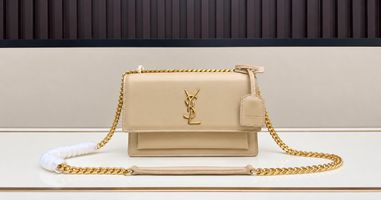
Inside the Saint Laurent Sunset: How Much Room Do You Really Get?
When considering YSL Sunset bag for women as a daily accessory, storage matters more than the exterior dimensions might suggest. The accordion compartments help separate essentials, but rigid objects can be difficult to accommodate. A phone, slim wallet, keys, and small cosmetics are reasonable starting points when judging capacity.
What matters most is how those belongings fit together, not simply whether each one fits individually.
1. Why Exterior Size Can Be Misleading
The Sunset has a rectangular outline that gives little indication of how the available space is distributed inside.
From the outside, its depth may suggest more room than the individual compartments actually provide. Opening the flap reveals a series of separated sections, each with its own usable width and depth.
That arrangement differs considerably from a soft pouch, where belongings can settle together and occupy nearly the entire interior.
Consider two objects of similar overall size: a thin leather wallet and a rigid sunglasses case. The wallet can lie against a compartment wall, while the case requires more uninterrupted space around its edges.
A bag may accommodate the wallet easily but struggle with the case, despite the objects appearing comparable when placed beside each other.
The accordion construction provides some movement as the sections open. It does not remove the boundaries created by the internal dividers.
External dimensions remain useful for understanding the bag's overall proportions, although they cannot establish exactly which belongings will fit.
That requires a closer look at the interior.
2. Start With the Objects You Reach For Most
A practical packing routine begins with access rather than appearance.
Think about what happens during a typical morning. A phone comes out to check a message. A wallet is needed at a coffee shop. Keys are retrieved at the office or outside the car.
These objects should occupy positions that make repeated access straightforward.
Place the phone in a section where its top edge can be reached without moving other belongings. Keep the wallet separate if space allows, particularly when it contains cards that are used frequently.
Keys are more complicated. A small key ring can settle into a corner, but a large electronic car key or decorative attachment may need a more accessible location.
Smaller accessories can occupy pockets that are less convenient for a phone or wallet.
This approach creates a hierarchy within the bag. Frequently used objects receive the most accessible spaces; occasional items can sit farther inside.
Try removing each essential and returning it without looking directly into the compartments.
If that process feels awkward when the bag is sitting on a table, it may become more inconvenient while standing in a crowded store or moving through a station.
The goal is a repeatable arrangement that does not require constant attention.
3. Small and Medium Are Different Carrying Decisions
Choosing YSL Sunset bag proportions involves more than comparing two widths on a product page.
Small versions generally provide a compact rectangular outline that can feel discreet against the body. Medium configurations have a broader presence and may allow more separation between belongings, depending on their construction.
One Medium configuration has been listed with exterior dimensions of approximately 8 × 6.2 × 2.5 inches. That specification should not be applied automatically to every production year or material variation.
The measurements are useful for understanding the exterior, but they do not reveal the full dimensions of each internal section.
An additional inch of overall width, for example, does not necessarily provide an extra inch of uninterrupted space for a long wallet.
Proportions also change the wearing experience.
A smaller bag can sit closer to the torso and create a relatively restrained outline. A Medium version may become more visible when carried crossbody, particularly over lightweight summer clothing.
Under a substantial winter coat, those differences can look less dramatic.
The decision is partly about storage and partly about how the bag relates to the wearer's frame.
Anyone comparing the two should check the precise dimensions of the versions available rather than relying only on the size names.
4. The Problem With Rigid Objects
Flexible items tend to cooperate with divided storage. Rigid accessories demand space that cannot easily be rearranged.
A fabric pouch can compress slightly beside a wallet. Tissues can occupy a narrow opening. A slim cardholder can rest against a compartment wall.
Sunglasses cases, compact cameras, and bulky accessories behave differently.
Their dimensions remain fixed, so each object needs enough room to enter and leave the compartment without excessive pressure.
A case may appear to fit when held against the exterior of the bag, yet the opening could be too narrow for comfortable access.
Orientation matters as well.
An object that does not fit horizontally might fit vertically, but that position can interfere with the flap or make the item difficult to retrieve.
Soft protective alternatives may help in some situations, provided they still protect the contents adequately.
There is little benefit in forcing an object into a space that leaves the bag visibly distorted.
For anyone who regularly carries rigid accessories, checking their actual dimensions against the available compartment openings is more useful than estimating capacity by eye.
5. How Divided Compartments Change Storage
Shoppers interested in Yves Saint Laurent Sunset bag will find that its divided interior offers a different experience from carrying an open, single-compartment shoulder bag.
Certain Medium configurations feature two main compartments along with additional smaller pockets. The exact arrangement varies by model and should be verified against the product being considered.
A flat pocket can be useful for cards or similarly slim objects. Larger sections provide room for essentials that need more depth.
The practical benefit is separation.
A phone does not necessarily have to share space with keys, and small items can remain away from objects that might scratch them.
There is a physical cost to that arrangement, however.
Dividers occupy room and establish boundaries that larger belongings cannot cross. The available space is distributed rather than collected into one continuous cavity.
The accordion sides allow the sections to open for access, but the interior still functions as several distinct areas.
Someone accustomed to a soft, open shoulder bag may initially find this unfamiliar.
After a few days of regular use, the arrangement may become easier because each item has an expected location.
That convenience depends on choosing belongings that fit comfortably within the sections rather than forcing the interior to accommodate objects it was not designed to carry.
6. Check Dimensions Before Assuming a Fit
Phone and wallet sizes have changed enough over time that general statements about handbag capacity can be misleading.
A compact smartphone and a larger Pro Max-style device may require noticeably different amounts of compartment width. Protective cases introduce another variable, especially when they have thick corners or attached accessories.
The same applies to wallets.
A slim cardholder occupies relatively little depth. A long continental wallet requires greater uninterrupted width, even if it is not especially thick.
For a realistic comparison, measure the objects rather than relying on their product names.
Phone width, including the case, matters when the opening is narrow. Wallet thickness becomes important when several belongings share the same section.
Do not overlook items with irregular shapes. A car key with a large fob, an earbuds case, or a cosmetic compact may prevent other belongings from sitting flat.
Testing the opening is just as important as testing the space inside.
An object that fits once positioned in the compartment may still be inconvenient if it has to be tilted or turned every time it is removed.
Leave enough room to retrieve frequently used belongings without pulling apart the entire arrangement.
For buyers who cannot inspect the bag in person, exact product measurements and photographs of the open interior are more informative than a general claim that it holds everyday essentials.
7. When Medium Makes More Sense
Medium is worth considering when the smaller version leaves too little room for the items that genuinely need to travel together.
Suppose a daily routine requires a large phone, full-size wallet, electronic car key, and several small personal accessories. A broader configuration may allow those belongings to be distributed more comfortably.
The benefit is not necessarily carrying more objects. It may simply be avoiding an arrangement where everything presses against something else.
Medium can also be useful when a buyer wants the bag to look more substantial over coats or tailored clothing.
However, the larger outline should be considered alongside weight and carrying position.
Additional space makes it tempting to add more belongings, and the resulting load may feel different after an extended period on the shoulder.
Before selecting a version, compare the available YSL Sunset women's bag specifications with the dimensions of the accessories you already own.
Pay particular attention to the construction of the compartments rather than assuming that the exterior width translates directly into usable storage.
If the larger configuration accommodates those belongings without crowding the interior, Medium may be the more convenient choice.
There is little reason to select it solely for the size label when the smaller version already handles the intended contents comfortably.
8. What Happens When the Bag Is Full
Overpacking a structured handbag can change how it opens and closes.
As belongings accumulate, the compartments have less room to move. Objects may press against the dividers, while the flap can require additional effort to fasten.
The accordion sides are part of the construction, but they are not intended to be stretched indefinitely.
Repeated pressure against leather panels and closures may contribute to wear over time.
Crowding also changes access.
A phone that originally sat upright may lean against another object. Smaller belongings can become trapped beneath a wallet or case, making it necessary to rearrange the interior before retrieving them.
There is a simple way to evaluate the packing arrangement.
Fill the bag with the items you expect to carry, close it normally, and then remove the three objects used most frequently.
Return each item to its original place without moving everything else.
If the process remains straightforward, the arrangement is more likely to work during ordinary use.
If the flap requires pressure to close or belongings repeatedly catch against the opening, the bag is probably carrying more than is comfortable for that configuration.
9. The Unexpected Extra-Item Problem
A handbag can work beautifully for a predictable morning and become inconvenient when the day's plans change.
Imagine leaving home with only the usual essentials. Everything has an assigned compartment, and the bag closes easily.
Later, a pair of prescription glasses needs to be stored in its case. There may be unused space in several sections, yet none offers the right uninterrupted dimensions for the case.
The problem is not necessarily the overall volume.
It is the way the remaining space is distributed.
This situation also occurs with compact purchases, a portable charger, or small items collected during travel.
A soft shopping bag can accommodate unexpected objects more readily because its interior has fewer fixed boundaries. The Sunset requires a little more planning.
One solution is to carry a separate lightweight tote on days when additional belongings are likely.
Another is to reserve the structured bag for occasions when the contents are already known.
Neither approach requires changing the handbag itself. They simply acknowledge that compartmented storage is best suited to a relatively predictable set of objects.
10. Choosing Around Your Daily Essentials
Before deciding how much room is necessary, consider the items that must be carried for reasons beyond convenience.
For someone taking public transportation, a phone and transit card may need quick access. A driver may prioritize a car key and wallet. A person who wears prescription glasses may need to account for their case every day.
These priorities can influence YSL Sunset bag size selection more than a general packing list.
Start with the objects that cannot reasonably be left behind.
Then separate occasional accessories from genuine necessities.
A small cosmetic pouch might be useful but not essential. Medication, identification, or work-related access cards may be nonnegotiable.
Keep the existing accessories in mind. Replacing a familiar wallet or glasses case purely to make a handbag functional may not be an attractive compromise.
If the bag accommodates the essentials without pressure on the closure, there is a stronger reason to consider it.
If several important belongings require awkward positioning, the dimensions may not suit the intended routine.
This method also helps prevent overestimating capacity based on product photographs, where bags are frequently shown empty or with very limited contents.
11. Which Size Fits Your Routine?
Small makes sense when compact proportions are a priority and the daily essentials fit comfortably within the available sections.
It can be a useful choice for someone who carries a phone, slim wallet, keys, and a few small accessories without frequently adding larger belongings.
Medium becomes more compelling when extra compartment space serves a clear purpose.
That might mean accommodating a larger phone, allowing belongings to remain separated without crowding, or providing a slightly more substantial silhouette against outerwear.
The deciding factor is the actual configuration.
Two handbags with similar exterior measurements may offer different usable space because of the placement and thickness of their internal dividers.
The opening also matters. Belongings should be easy to remove and return, not merely possible to fit inside.
Before committing to a size, verify the product's current dimensions and interior arrangement. When possible, test the bag with the objects that normally leave home with you.
A well-chosen Sunset should allow those essentials to remain accessible without requiring constant repacking.
The most useful capacity is the amount that still feels convenient after the bag has been opened and closed throughout the day.
Sophia Carter
Sophia Carter is a fashion writer focused on luxury accessories,designer handbags,and modern styling.She creates practical guides that help shoppers evaluate materials,understand design details,and choose pieces for different occasions.